

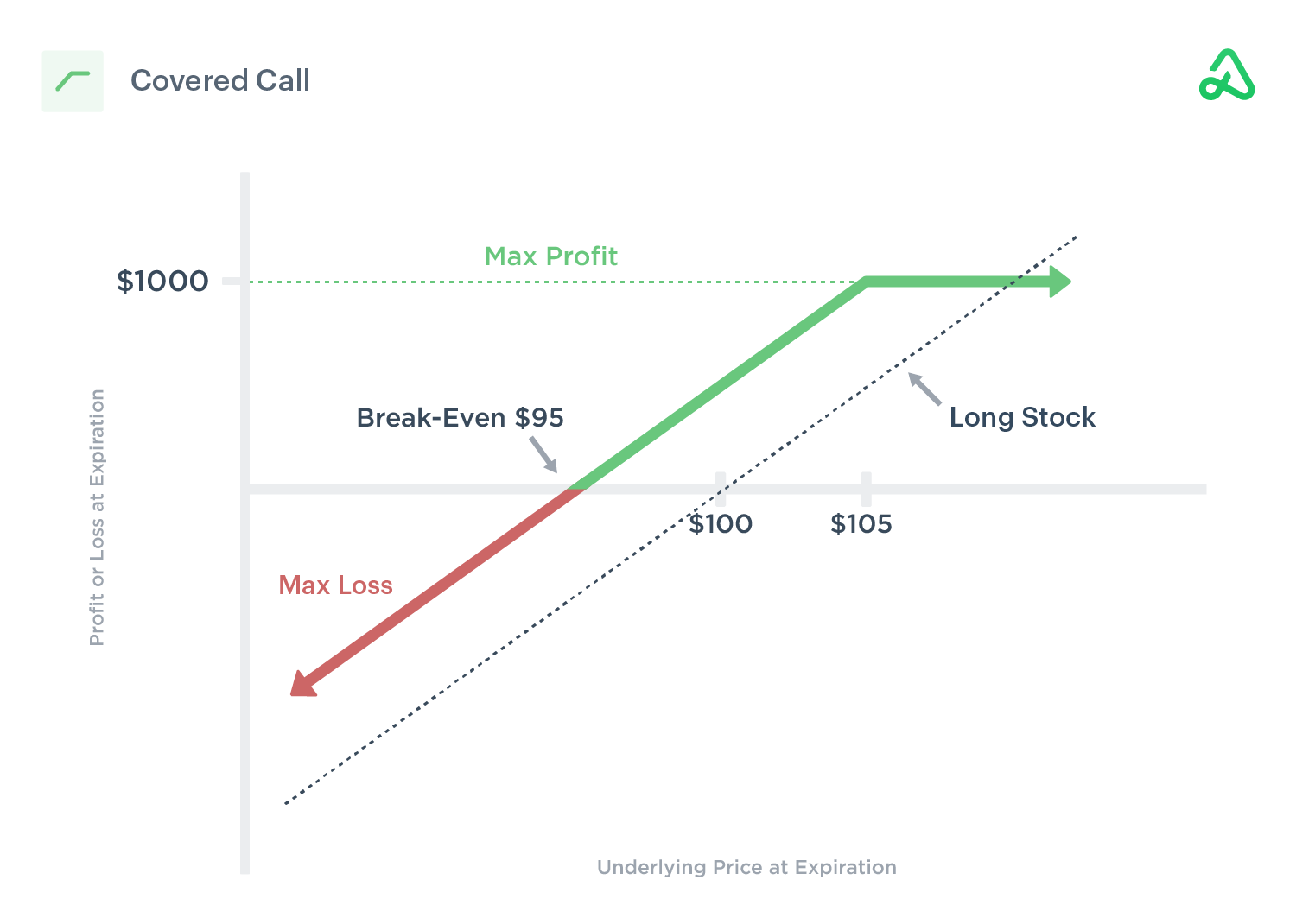
Covered call payoff diagram
To enter a poor man’s covered call, buy an in-the-money (ITM) call option and sell an out-of-the-money (OTM) call option with a shorter-dated expiration.
The longer-dated, deep ITM call acts similar to a long stock position because of its high positive delta. However, the call option has a much lower capital requirement than owning 100 shares of the stock.
The short OTM call is sold on a recurring basis to generate income, but limits the position’s upside potential.
The strategy reduces risk and capital requirements compared to purchasing stock, making it an ideal option for investors looking to increase their long exposure to a security without holding a long equity position in the underlying.
The main downside to the strategy is if the underlying stock price makes a large move in either direction before expiration. If the stock price rallies sharply higher, the long ITM call’s value increases, but the short OTM call limits upside potential. Similarly, the short OTM call will decrease if the stock price falls sharply lower, but the long ITM call will also lose value.
Poor man’s covered call vs. covered call #
There are a few key differences between a poor man’s covered call and traditional covered calls. As the name implies, a poor man’s covered call is a less expensive version of a covered call.
A covered call strategy involves buying a stock and selling an OTM call. The key benefit of a covered call is that it allows the trader to generate income from selling the call. The premium received reduces the equity position’s cost basis and risk and establishes an upside price target.
However, if the short call option is ITM on or before its expiration, the option holder can choose to call the shares away, and you’d be obligated to sell shares at the option’s strike price.
A PMCC can reduce some of the risks of a traditional covered call strategy. Buying an equity position requires more capital than buying a call option. Call options leverage owning 100 shares (per contract) without risking as much capital.
Poor man’s covered calls replace the long equity position with a deep ITM call. The initial debit paid is the maximum possible loss for the call option, no matter the underlying’s price.
A trader with an equity position has the same defined risk (the total cost of the position). However, the capital outlay for an equity position is substantially more than the same notional exposure via a call option.
Capital Comparison Example #
For example, 100 shares of stock at $800 a share requires $80,000 in capital. In comparison, a long-dated, deep ITM call option may cost $9,415, a fraction of the long equity position’s cost.
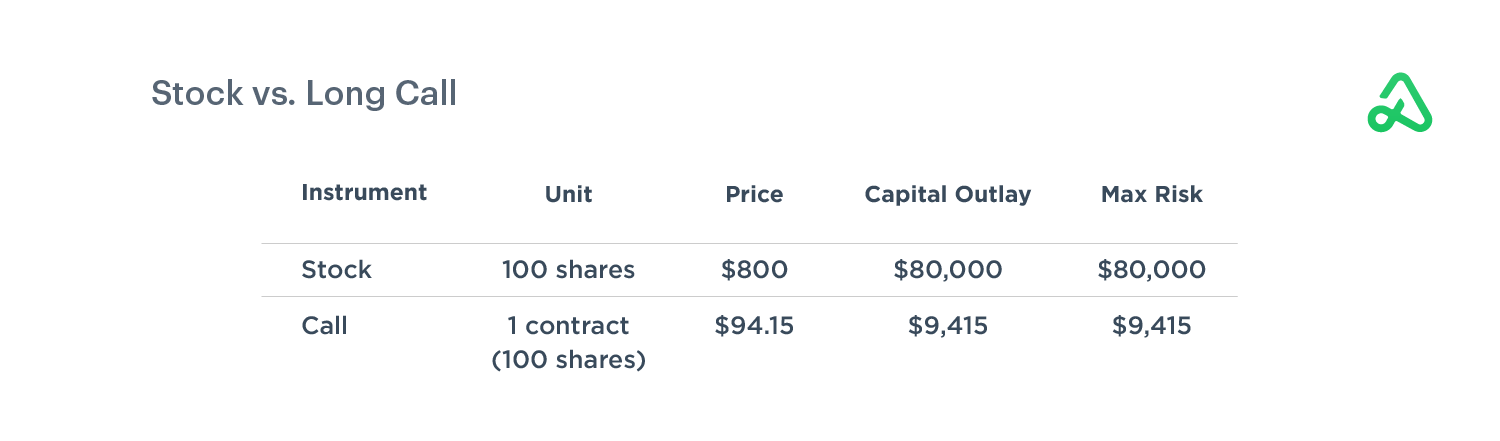
Long stock vs long call position
As you can see, the PMCC is much less capital intensive than a traditional covered call. In both strategies, the short call generates the same income.
Furthermore, if the stock’s price goes down by 50%, you would lose $40,000 with the long equity position, while the PMCC’s maximum loss is the cost of the premium ($9,415 in this example).
Poor man’s covered call risks #
The risks of a poor man’s covered call are primarily related to time horizon and mismanagement. A call option has a fixed expiration date. Choosing an expiration that matches your time horizon for the expected move in the underlying is critical.
For example, if you expect a stock to hit the upper price target sometime in the next six months, you’ll want to choose an option with at least a six-month expiration.
By comparison, long equity positions are not constrained by an expiration date. As mentioned, the short call limits the position’s upside potential. If the underlying stock price exceeds the call option, you forfeit any gains above the contract’s strike price.
However, the short call also reduces risk by continuously reducing the position’s cost basis.
Automating PMCC with bots #
Automation makes entering and managing a poor man’s covered call effortless and eliminates the burdens associated with manual trading. Here’s how you can automate a PMCC strategy using Option Alpha.
Open a long call position #
PMCCs typically have long-dated expirations, or LEAPS, because the longer time frame more closely resembles a stock position and allows you to sell multiple covered calls over the life of the LEAP to reduce your cost basis.
Deep in-the-money calls are generally used, because higher delta options more closely resembles a stock position. The closer the contract’s delta is to 1, the more the option acts like 100 shares.
This bot uses 150 DTE and a 0.80 delta for the long call. We also included decisions confirming sufficient capital is available and the bot’s position limits have not been reached.
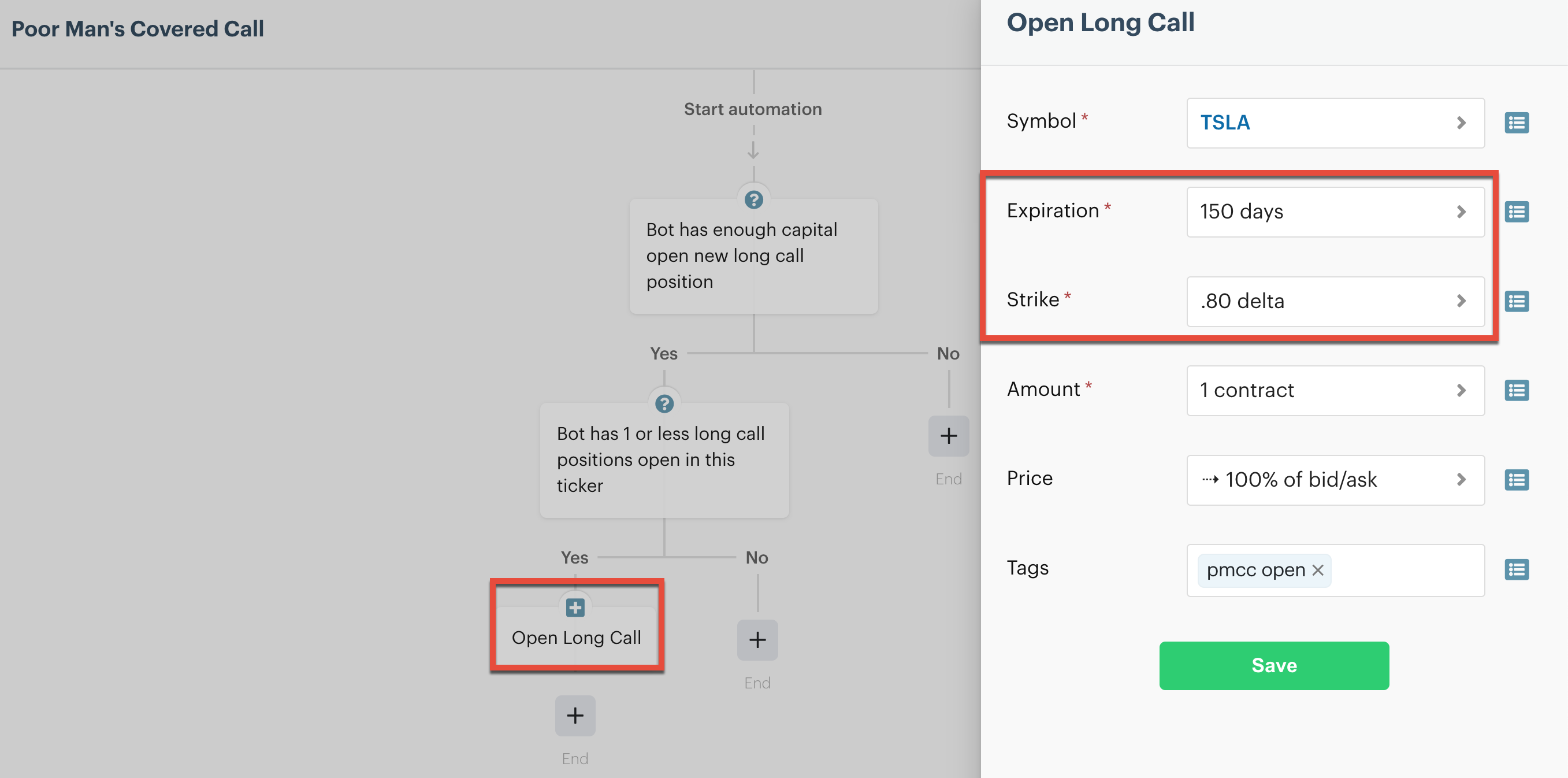
Open long call
Open the short call #
Before adding the covered call, the bot confirms there is a long call already open in the specific ticker and a short call spread is not yet open.
The short call spread must expire before the long call. The bot opens a short call 30 days from expiration at the 0.30 delta in this example.
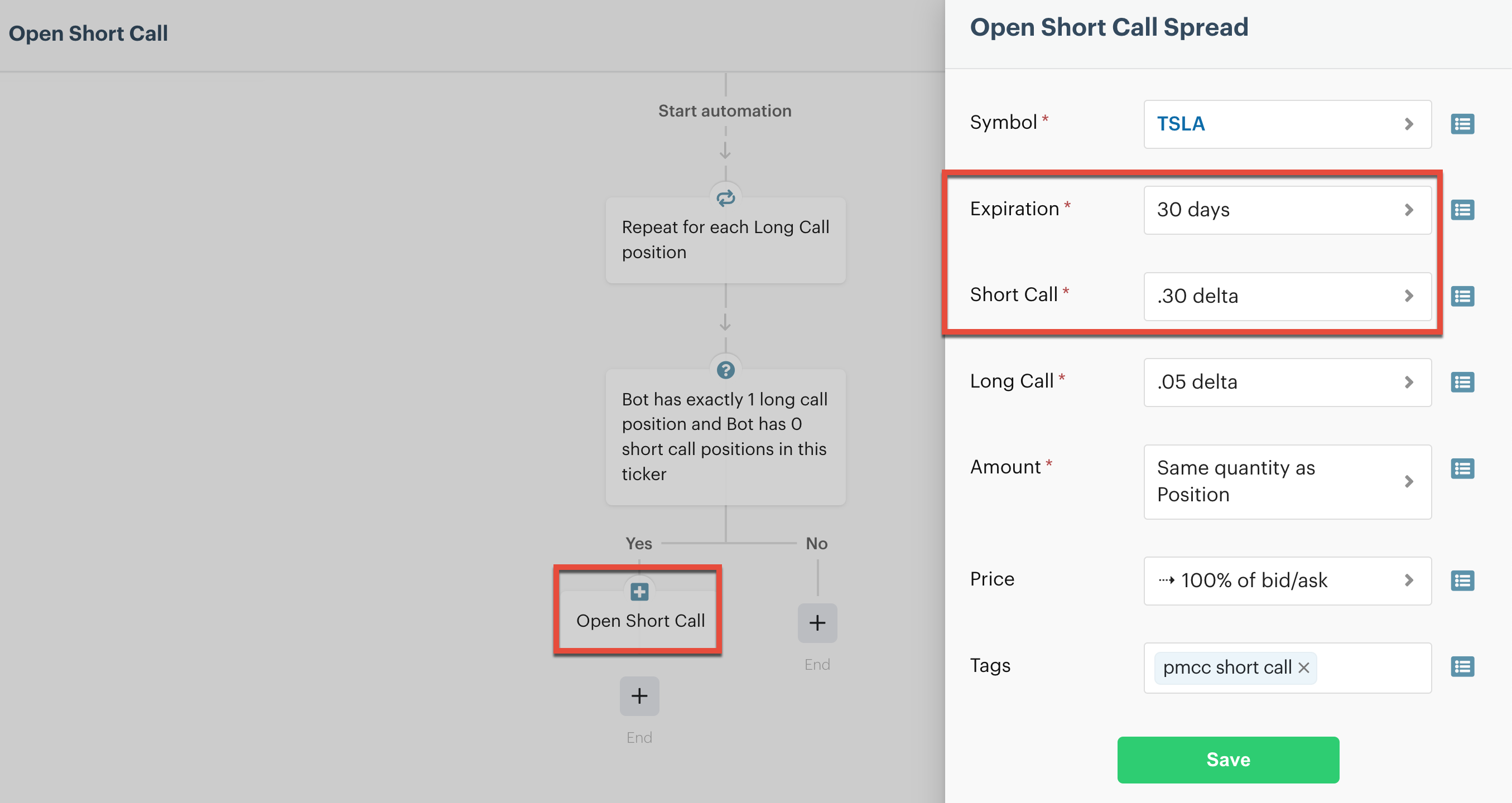
*The autotrading platform does not support naked option selling; the short call component of the strategy must be a call spread
Create a monitor automation to manage each position #
The bot closes all open positions when the profit is greater than $150 or the total P/L is -$150.
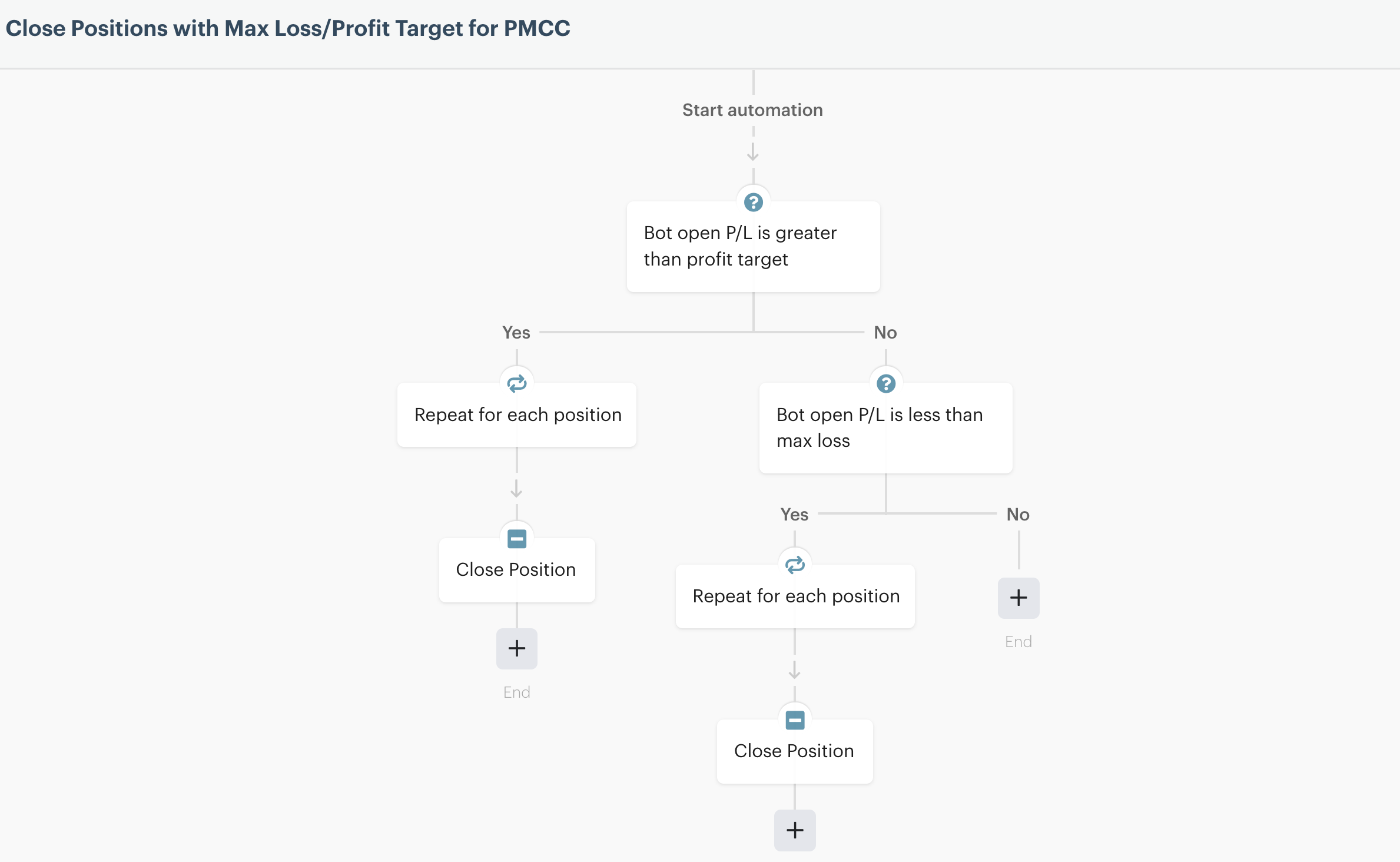
Poor man’s covered call monitor automation
You can adjust profit targets based on your risk profile and capital allocation. The beauty of bots is that they remove human judgment and error from the equation. If the total profit is achieved, the bot closes each position for a profit. If the P/L breaches the stop loss, the bot closes the position and is ready to open the next poor man’s covered call.