

What is a Covered Call? #
Think of it as renting out your stocks - you get paid rent (the premium), but you might have to sell your stocks at a predetermined price if they’re “called away.”
The Mechanics #
Components of a Covered Call #
- Long Stock Position: You own 100 shares of stock (or multiples of 100)
- Short Call Option: You sell 1 call option contract per 100 shares
- Strike Price: The price at which you agree to sell your shares
- Premium: The income you receive for selling the call option
- Expiration Date: When the option contract expires
Visual Representation #
graph TD
    A[You Own 100 Shares
Current Price: $50] --> B{Sell 1 Call Option}
    B --> C[Strike Price: $55
Premium Received: $2/share
Expiration: 30 days]
    C --> D{At Expiration}
    D -->|Stock < $55| E[Keep Shares
Keep Premium
Total Profit: $200]
    D -->|Stock > $55| F[Shares Called Away
Sell at $55
Profit: $500 + $200 = $700]
Practical Example #
Let’s walk through a real-world scenario:
Setup #
- Stock: Apple (AAPL)
- Current Price: $180 per share
- Shares Owned: 100 shares
- Total Investment: $18,000
The Trade #
You sell 1 call option:
- Strike Price: $190
- Premium: $3.50 per share
- Expiration: 30 days
- Premium Received: $350 (100 shares × $3.50)
Possible Outcomes #
Scenario: Stock Stays Below $190
Day 0:  Stock at $180, Sell call for $3.50/share
Day 30: Stock at $185 (below strike)

Result:
- Keep your 100 shares
- Keep the $350 premium
- Annualized return on premium: ~23% ($350/$18,000 × 12 months)
- Can sell another call option next monthYou keep your shares AND the premium. Rinse and repeat next month!
Scenario: Stock Goes Above $190
Day 0:  Stock at $180, Sell call for $3.50/share
Day 30: Stock at $200 (above strike)

Result:
- Shares called away at $190 (Your stock gets sold at $190)
- Profit on shares: $1,000 ($190 - $180 × 100)
- Premium kept: $350
- Total profit: $1,350
- Missed gains: $1,000 (stock went to $200, but you sold at $190)You still profit, but miss out on gains above the strike price.
Side-by-Side Comparison
| Scenario | Stock Price | Shares Status | Premium | Stock Gain | Total Profit | Opportunity Cost |
|---|---|---|---|---|---|---|
| Keep Shares | $185 | Keep | $350 | $500 | $850 | $0 |
| Called Away | $200 | Sold at $190 | $350 | $1,000 | $1,350 | $1,000 |
| Buy & Hold | $200 | Keep | $0 | $2,000 | $2,000 | N/A |
Covered calls outperform in flat/slight-up markets, but underperform when stocks rally hard.
Visual P&L Diagram #
Real Broker Example #
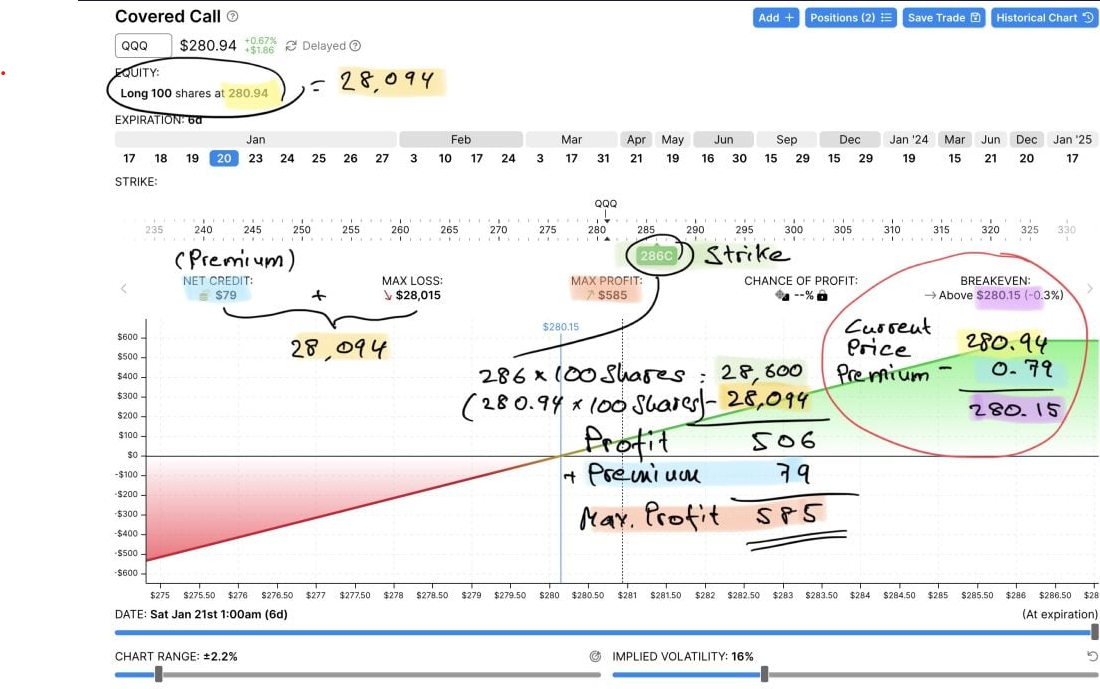
When to Use Covered Calls #
- Neutral to Slightly Bullish Outlook: You think the stock will stay flat or rise modestly
- Generate Income: You want regular cash flow from your portfolio
- Willing to Sell: You’re comfortable selling your shares at the strike price
- Higher IV Environment: When implied volatility is elevated, premiums are juicier
- Strongly Bullish: You expect significant upside movement - don’t cap your gains!
- Before Earnings/News: Major events can cause large price swings
- Need Liquidity: You might need to sell shares before expiration
- Falling Knife: If the stock is in a downtrend, the premium won’t offset losses
Risk/Reward Profile #
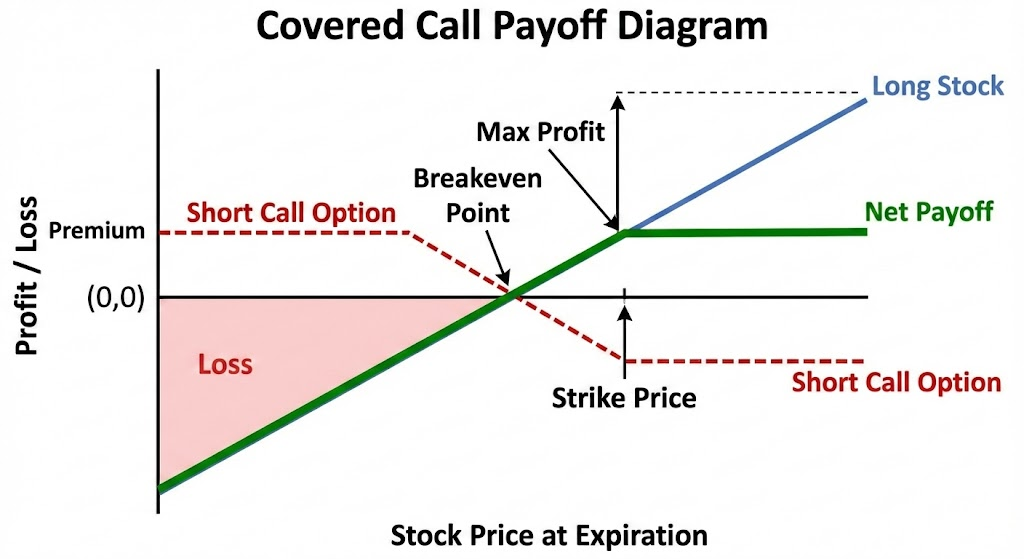
Maximum Gain #
Max Profit = Premium Received + (Strike Price - Stock Purchase Price) × 100

Example: $350 + ($190 - $180) × 100 = $1,350
Maximum Loss #
Max Loss = (Stock Purchase Price × 100) - Premium Received

Example: ($180 × 100) - $350 = $17,650
Note: This is the same risk as owning the stock, minus the premium collected. Only sell covered calls on stocks you actually want to own. Quality bluechips stocks
Breakeven Point #
Breakeven = Stock Purchase Price - Premium per Share

Example: $180 - $3.50 = $176.50
Visual Comparison: Covered Call vs Buy & Hold #
graph LR
    A[Stock Position] --> B[Buy & Hold Strategy]
    A --> C[Covered Call Strategy]

    B --> D[Unlimited Upside
Full Downside Risk
No Premium Income]

    C --> E[Capped Upside
Reduced Downside
Premium Income]

    classDef traditional fill:#3b82f6,stroke:#2563eb,color:#fff
    classDef enhanced fill:#f59e0b,stroke:#d97706,color:#fff

    class B traditional
    class C enhanced
Advanced Considerations #
Rolling the Option #
If the stock approaches your strike price and you want to keep your shares, you can “roll” the option:
Step 1: Buy back the current call (close position)
Step 2: Sell a new call with later expiration or higher strike
Example:
- Current: $190 strike expiring in 5 days, stock at $189
- Action: Buy back for $2, sell $195 strike 30 days out for $4
- Net credit: $2 per share ($200 total)
Real-World Performance #
Monthly Income Example #
Portfolio: 1,000 shares across 10 stocks (100 shares each at avg $100/share)
| Month | Premium/Share | Total Premium | Annualized Yield |
|---|---|---|---|
| Jan | $2.50 | $2,500 | 30% |
| Feb | $2.25 | $2,250 | 27% |
| Mar | $3.00 | $3,000 | 36% |
| Q1 Total | $7.75 | $7,750 | 31% annualized |
Assumptions: All calls expired worthless (stocks stayed below strikes)
Key Takeaways #
- Income Generation: Covered calls provide consistent premium income. Aim for 85% profit capture (e.g., close the position when you’ve earned most of the premium) and exit before expiry to minimize assignment risk. Unless you want your stocks to be sold.
- Limited Upside: Your gains are capped at the strike price
- Downside Protection: Premium reduces cost basis but doesn’t eliminate risk
- Best for Flat Markets: Works well when stocks trade sideways
- Flexibility: You can adjust by rolling options or letting them expire
Common Mistakes to Avoid #
- Setting strikes too low - Increases chance of shares being called away. Give yourself some room!
- Ignoring ex-dividend dates - May result in early assignment right before the dividend
- Overleveraging - Selling too many contracts relative to portfolio size
- Panic rolling - Rolling options at unfavorable prices when you should just let them expire
Conclusion #
Covered calls are a conservative options strategy that can enhance returns in neutral to slightly bullish markets. They work best when you:
- Own quality stocks you’re comfortable holding long-term or want to purchase new stocks (minimum 100)
- Want to generate additional income from your portfolio
- Accept capping your upside for premium income
- Have realistic expectations about returns
Remember: No strategy is perfect for all market conditions. Covered calls are just one tool in your investing toolkit.
Disclaimer: This is educational content only. Options trading involves risk and is not suitable for all investors. Do your research!