

After trading PMCCs for a few years, I’ve realized this isn’t just a cheaper alternative—it’s more capital-efficient with similar income potential. But mess up the setup, and you’ll bleed money fast.
What is a PMCC? #
A PMCC mimics a traditional covered call but uses a long-term deep ITM call option (LEAP) instead of owning 100 shares.
- Buy 100 shares (e.g., AAPL at $260 = $26,000)
- Sell short-term OTM call against shares
- Collect premium income
- Buy deep ITM LEAP instead of shares (e.g., $4,000-$6,000)
- Sell same short-term OTM call against your LEAP
- Collect similar premium with 70-80% less capital
The key to PMCC success: treat your LEAP as synthetic stock. Buy it deep ITM with 0.80+ delta so it moves almost 1:1 with the underlying.
PMCC Payoff Profile #
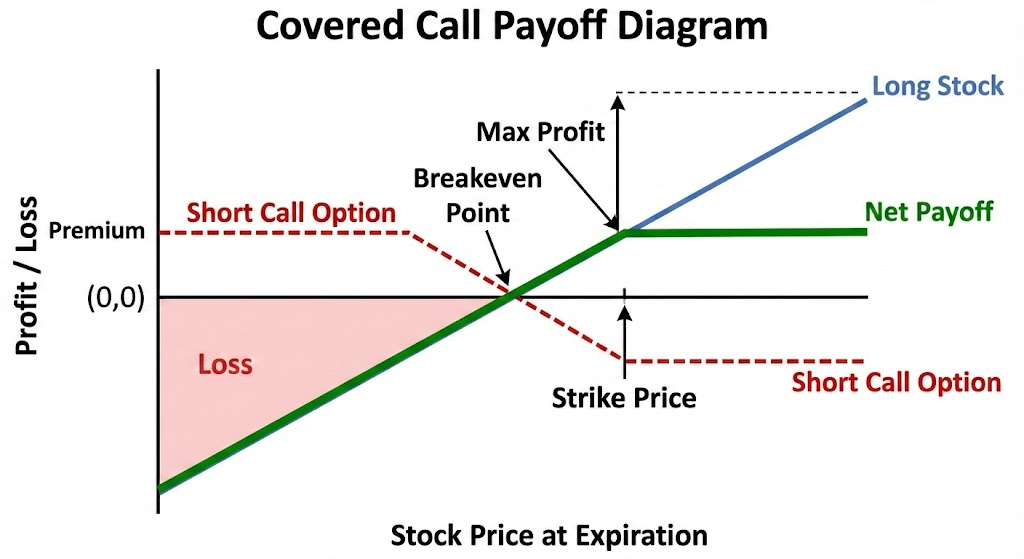
- Max Loss (left flat): Net debit paid—capped, unlike stock ownership
- Rising diagonal: Profit increases between LEAP strike and short strike
- Max Gain (right flat): Capped above short call strike
- Breakeven: LEAP strike + net premium paid
The Two Components #
Requirements:
- Expiration: 12-18+ months out
- Strike: Deep ITM with 0.80+ delta
- Moneyness: $20-40 below current price
Example - AAPL at $260:
- Jan 2027 $230 call
- Delta: ~0.82
- Cost: ~$3,500-$4,000
With 0.82 delta, if AAPL moves up $1, your LEAP gains ~$0.82.
Requirements:
- Expiration: 30-45 days out
- Strike: OTM, above LEAP breakeven
- Delta: 0.20-0.35
- Target: 1-2% of LEAP cost monthly
Example - AAPL at $260:
- Feb 2026 $270 call
- Delta: ~0.30
- Premium: ~$250-$300
Collect this premium every 30-45 days.
Never buy an ATM or OTM LEAP. You need 0.80+ delta or the position won’t behave like a covered call.
Step-by-Step Setup: AMD Example #
AMD at $219 (January 2026)
graph LR
    A[Buy LEAP] --> B[Sell Short Call]
    B --> C[Collect Premium]
    C --> D[Manage/Roll]
    D --> B
| Component | Details |
|---|---|
| Long LEAP | Jan 2027 $180 call, delta ~0.82, cost ~$4,800 |
| Short Call | Feb 2026 $230 call, delta ~0.30, premium ~$380 |
| Net Investment | $4,420 ($4,800 - $380) |
| Max Profit | $1,480 (if AMD closes above $230) |
| ROI This Cycle | 33% on $4,420 |
| Capital Saved | $17,480 vs. owning 100 shares |
Managing Your Position #
Critical Rules:
- Roll before expiration - Assignment destroys your LEAP’s time value
- Maintain delta spread - Keep LEAP delta 0.50+ higher than short call delta
- Avoid earnings - Close or roll short call before announcements
Risks to Respect #
PMCC vs. Traditional Covered Call #
| Factor | Traditional CC | PMCC |
|---|---|---|
| Capital Required | $25,000+ | $4,000-7,000 |
| Monthly Return % | ~1-2% | ~1-2% |
| Management | Passive | Active |
| Assignment Risk | None | Must roll |
| Best For | Long-term holdings | Bullish plays with limited capital |
I use traditional covered calls on core holdings like VTI. I use PMCCs on individual stocks I’m bullish on but don’t want to tie up $25,000+ (like high-priced tech names).
Quick Checklist #
- ✅ Choose quality underlying (large-cap, bullish outlook)
- ✅ Buy deep ITM LEAP (12+ months, 0.80+ delta)
- ✅ Sell 30-45 day OTM call (0.20-0.35 delta)
- ✅ Set reminders to check weekly
- ✅ Roll before expiration or assignment
- ✅ Start with one contract, scale slowly
Paper trade your first PMCC for 60 days. The nuances only become clear when you manage them in real-time.
Sources:
Disclaimer: This article is for educational purposes only and is not financial advice. Options trading involves significant risk.