

What is a Covered Call? #
A covered call is an options strategy where you own shares of a stock and sell call options against those shares. This allows you to generate additional income from stocks you already own, but it also caps your upside potential if the stock price rises significantly.
Think of it as renting out your stocks - you get paid rent (the premium), but you might have to sell your stocks at a predetermined price if they’re “called away.”
The Mechanics #
Components of a Covered Call #
- Long Stock Position: You own 100 shares of stock (or multiples of 100)
- Short Call Option: You sell 1 call option contract per 100 shares
- Strike Price: The price at which you agree to sell your shares
- Premium: The income you receive for selling the call option
- Expiration Date: When the option contract expires
Visual Representation #
graph TD
    A[You Own 100 Shares<br/>Current Price: $50] --> B{Sell 1 Call Option}
    B --> C[Strike Price: $55<br/>Premium Received: $2/share<br/>Expiration: 30 days]
    C --> D{At Expiration}
    D -->|Stock < $55| E[Keep Shares<br/>Keep Premium<br/>Total Profit: $200]
    D -->|Stock > $55| F[Shares Called Away<br/>Sell at $55<br/>Profit: $500 + $200 = $700]
Practical Example #
Let’s walk through a real-world scenario:
Setup #
- Stock: Apple (AAPL)
- Current Price: $180 per share
- Shares Owned: 100 shares
- Total Investment: $18,000
The Trade #
You sell 1 call option:
- Strike Price: $190
- Premium: $3.50 per share
- Expiration: 30 days
- Premium Received: $350 (100 shares × $3.50)
Possible Outcomes #
Scenario 1: Stock Stays Below $190 #
Day 0:  Stock at $180, Sell call for $3.50/share
Day 30: Stock at $185 (below strike)

Result:
- Keep your 100 shares
- Keep the $350 premium
- Annualized return on premium: ~23% ($350/$18,000 × 12 months)
- Can sell another call option next month
Visual P&L Diagram:
Profit/Loss at Expiration
         │
   $350  ├─────────────────────────────
         │                            ╱
         │                          ╱
         │                        ╱
      $0 ├──────────────────────╱────── Strike: $190
         │                    ╱
         │                  ╱
         │                ╱
         └────────────────┴────────────── Stock Price
                        $190
Scenario 2: Stock Goes Above $190 #
Day 0:  Stock at $180, Sell call for $3.50/share
Day 30: Stock at $200 (above strike)

Result:
- Shares called away at $190 (Your stock gets sold at $190)
- Profit on shares: $1,000 ($190 - $180 × 100)
- Premium kept: $350
- Total profit: $1,350
- Missed gains: $1,000 (stock went to $200, but you sold at $190)
Comparison Table:
| Scenario | Stock Price at Expiration | Shares Status | Premium | Stock Gain | Total Profit | Opportunity Cost |
|---|---|---|---|---|---|---|
| Keep Shares | $185 | Keep | $350 | $500 | $850 | $0 |
| Called Away | $200 | Sold at $190 | $350 | $1,000 | $1,350 | $1,000 |
| Buy & Hold | $200 | Keep | $0 | $2,000 | $2,000 | N/A |
Another Example #
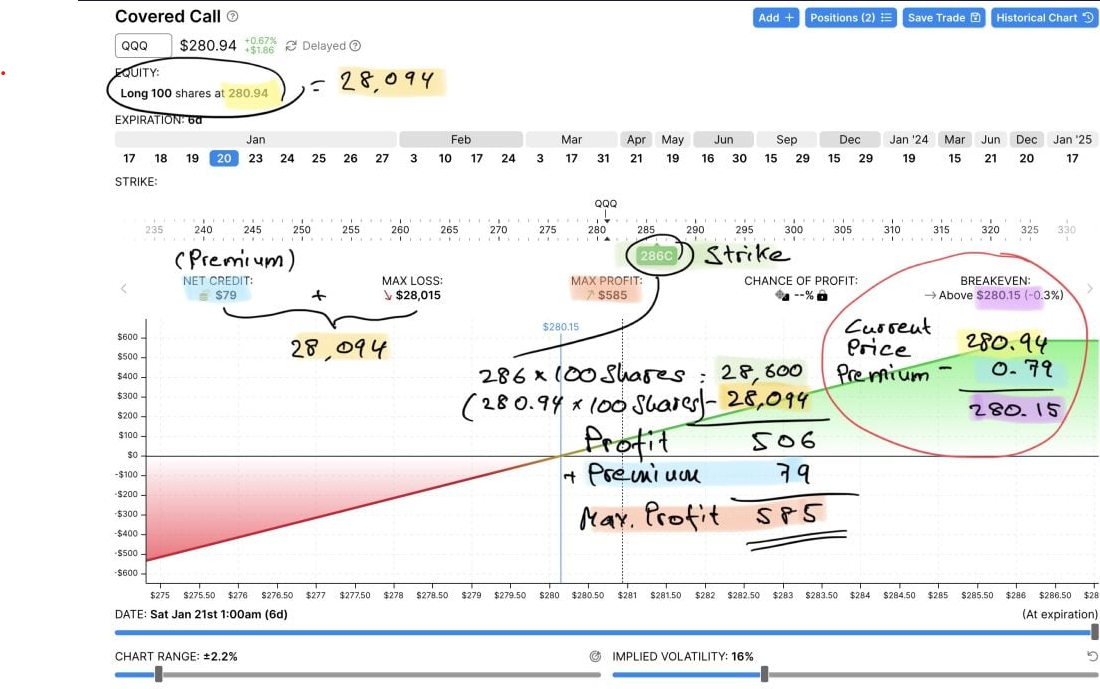

When to Use Covered Calls #
Ideal Situations ✅ #
- Neutral to Slightly Bullish Outlook: You think the stock will stay flat or rise modestly
- Generate Income: You want regular cash flow from your portfolio
- Willing to Sell: You’re comfortable selling your shares at the strike price
- Low Volatility Periods: When IV (implied volatility) is relatively high, premiums are better
Avoid When ❌ #
- Strongly Bullish: You expect significant upside movement
- Before Earnings/News: Major events can cause large price swings
- Need Liquidity: You might need to sell shares before expiration
Risk/Reward Profile #
Maximum Gain #
Max Profit = Premium Received + (Strike Price - Stock Purchase Price) × 100

Example: $350 + ($190 - $180) × 100 = $1,350
Maximum Loss #
Max Loss = (Stock Purchase Price × 100) - Premium Received

Example: ($180 × 100) - $350 = $17,650
Note: This is the same risk as owning the stock, minus the premium collected. Only sell covered calls on stocks you actually want to own. Quality bluechips stocks
Breakeven Point #
Breakeven = Stock Purchase Price - Premium per Share

Example: $180 - $3.50 = $176.50
Visual Comparison: Covered Call vs Buy & Hold #
graph LR
    A[Stock Position] --> B[Buy & Hold Strategy]
    A --> C[Covered Call Strategy]

    B --> D[Unlimited Upside<br/>Full Downside Risk<br/>No Premium Income]

    C --> E[Capped Upside<br/>Reduced Downside<br/>Premium Income]

    style B fill:#e1f5ff
    style C fill:#fff4e1
Advanced Considerations #
Rolling the Option #
If the stock approaches your strike price and you want to keep your shares, you can “roll” the option:
Step 1: Buy back the current call (close position)
Step 2: Sell a new call with later expiration or higher strike
Example:
- Current: $190 strike expiring in 5 days, stock at $189
- Action: Buy back for $2, sell $195 strike 30 days out for $4
- Net credit: $2 per share ($200 total)
Real-World Performance #
Monthly Income Example #
Portfolio: 1,000 shares across 10 stocks (100 shares each at avg $100/share)
| Month | Premium/Share | Total Premium | Annualized Yield |
|---|---|---|---|
| Jan | $2.50 | $2,500 | 30% |
| Feb | $2.25 | $2,250 | 27% |
| Mar | $3.00 | $3,000 | 36% |
| Q1 Total | $7.75 | $7,750 | 31% annualized |
Assumptions: All calls expired worthless (stocks stayed below strikes)
Key Takeaways #
- Income Generation: Covered calls provide consistent premium income. Aim for 85% profit capture (e.g., close the position when you’ve earned most of the premium) and exit before expiry to minimize assignment risk. Unless you want your stocks to be sold.
- Limited Upside: Your gains are capped at the strike price
- Downside Protection: Premium reduces cost basis but doesn’t eliminate risk
- Best for Flat Markets: Works well when stocks trade sideways
- Flexibility: You can adjust by rolling options or letting them expire
Common Mistakes to Avoid #
❌ Setting strikes too low: Increases chance of shares being called away ❌ Ignoring ex-dividend dates: May result in early assignment ❌ Overleveraging: Selling too many contracts relative to portfolio size ❌ Panic rolling: Rolling options at unfavorable prices
Conclusion #
Covered calls are a conservative options strategy that can enhance returns in neutral to slightly bullish markets. They work best when you:
- Own quality stocks you’re comfortable holding long-term or want to purchase new stocks (minimum 100)
- Want to generate additional income from your portfolio
- Accept capping your upside for premium income
- Have realistic expectations about returns
Remember: No strategy is perfect for all market conditions. Covered calls are just one tool in your investing toolkit.
Disclaimer: This is educational content only. Options trading involves risk and is not suitable for all investors. Do your research!