

An option wheel strategy is a complex options trading strategy that involves simultaneously buying and selling multiple options in order to generate a profit from price movements in the underlying security. This strategy is typically used by experienced traders who are comfortable with the risks and potential rewards of using options.
Above explanation is not how I am using the wheel strategy. In my case, the Option Wheel Strategy is a method of generating consistent option premiums by selling cash-secured puts and covered calls as part of a long-term trading strategy. This strategy is considered to have a lower risk profile compared to other options trading strategies, making it a popular choice among traders looking to generate passive income during early retirement. The goal of the option wheel strategy is to collect option premiums. It is important to note that this strategy should not be considered a replacement for long-term investments.
The options wheel strategy involves the use of two basic options trading strategies: selling cash-secured puts and selling covered calls. In order to implement this strategy, an investor must first understand how these strategies work.
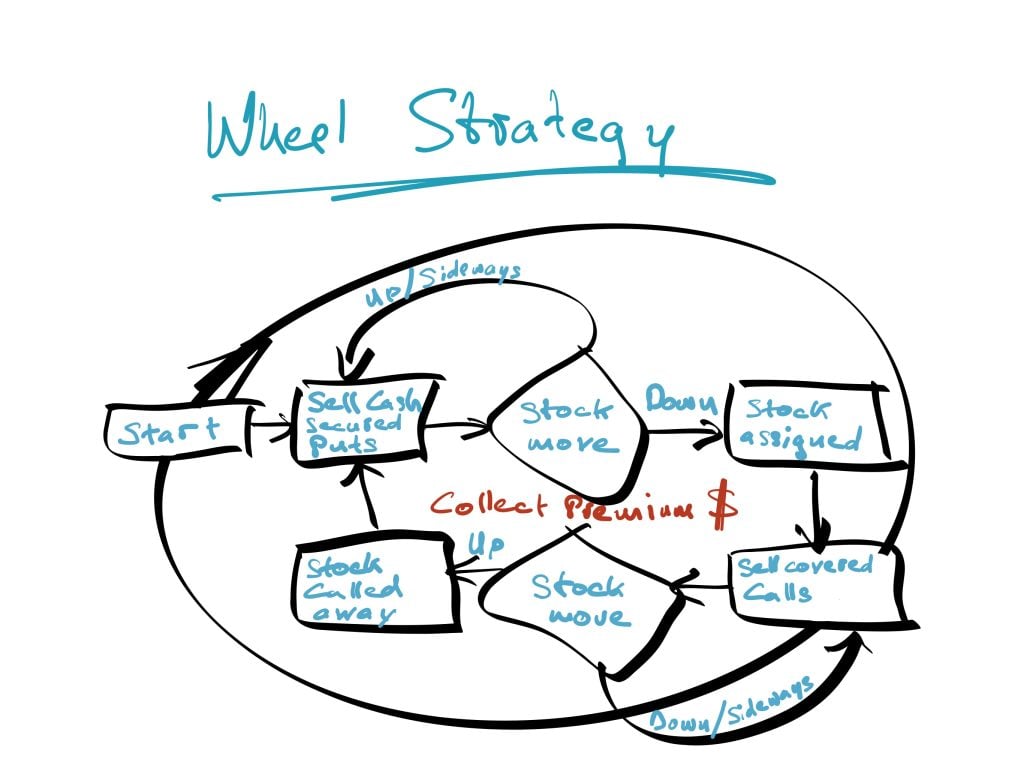
Wheel Strategy
Selling a cash-secured put involves selling a put option on a stock while having the cash on hand to buy the shares if the price drops below the strike price. For example, if an investor sells a $140 put option on AAPL stock that expires in a week, and the current price of AAPL is $142, there are two potential outcomes:
At the end of the week, the price of AAPL is $141 or higher. In this case, the option expires worthless and the investor keeps the premium because the price is above the strike price.
At the end of the week, the price of AAPL is below $140. In this case, the investor is required to buy 100 shares of AAPL at $140 (for a total cost of $14,000), but they will still keep the premium they received for selling the put option.
Selling a covered call involves selling a call option on a stock that the investor already owns. For example, if an investor owns 100 shares of AAPL stock and sells a $145 call option that expires in a week, there are two potential outcomes:
At the end of the week, the price of AAPL is below $145. In this case, the option expires worthless and the investor keeps the premium because the price is below the strike price.
At the end of the week, the price of AAPL is above $145. In this case, the investor is required to sell their 100 shares of AAPL at $145, but they will still keep the premium they received for selling the call option.
Once an investor understands these basic options trading strategies, they can use the option wheel strategy to simultaneously buy and sell multiple options in order to profit from price movements in the underlying security.
Cash Secured Put
A cash-secured put is a strategy in which an investor sells a put option on a stock while having the cash on hand to buy the shares if the price drops below the strike price. For example, if an investor sells a $140 put option on AAPL stock that expires in a week, and the current price of AAPL is $142, there are two potential outcomes:
At the end of the week, the price of AAPL is $141 or higher. In this case, the option expires worthless and the investor keeps the premium because the price is above the strike price.
At the end of the week, the price of AAPL is below $140. In this case, the investor is required to buy 100 shares of AAPL at $140 (for a total cost of $14,000), but they will still keep the premium they received for selling the put option.
In order to sell a cash-secured put, an investor must have at least $14,000 in cash available in their account in case the option is executed. This cash will be blocked from the investor’s account until the option either expires or is sold out of.
What is the Option Wheel Strategy:
The Options Wheel strategy is a simple approach to options trading that involves constantly selling cash-secured puts and covered calls. The strategy starts by selling cash-secured puts on a particular stock. This means that the investor sells a put option on the stock, with the intention of buying the shares at the strike price if the price drops below the strike. If the option is not exercised, the investor keeps the premium as profit. If the option is exercised, the investor must buy the shares, at which point they switch to selling covered calls on the stock. This involves selling a call option on the shares that the investor already owns, with the intention of selling the shares at the strike price if the price goes above the strike. If the option is not exercised, the investor keeps the premium as profit. If the option is exercised, the investor must sell the shares, and then the process starts over again by selling cash-secured puts on a new stock. This cycle of selling puts, buying shares, selling calls, and selling shares is repeated until the investor decides to exit the strategy.
How to choose the strike price:
When implementing the Options Wheel strategy, it is common for investors to use a delta value of 0.25 as a guide for selecting which options to trade. Delta is a measure of the expected price change of an option relative to the underlying security. A delta value of 0.25 means that the option is expected to gain or lose $0.25 in value for every $1.00 change in the price of the underlying security. By targeting a delta value of 0.25, investors can select options that are expected to provide a reasonable balance of potential profit and risk. Some trading platforms, such as Robinhood, provide a “Chance of Profit” column that can be used to evaluate the likelihood of profit for a given option based on its delta value. This can be helpful for investors who want to make more informed decisions about which options to trade.
Option Greeks:
Option Greeks are a set of metrics used to measure the various factors that can affect the price of an option. These metrics, also known as option sensitivities, are commonly referred to as “Option Greeks” because they are denoted by Greek letters. Some of the most commonly used Option Greeks include:
Delta: Delta measures the expected change in the price of an option relative to a $1.00 change in the price of the underlying security. A call option with a delta of 0.50, for example, is expected to increase in value by $0.50 if the underlying security increases in price by $1.00.
Gamma: Gamma measures the expected change in the delta of an option relative to a $1.00 change in the price of the underlying security. A call option with a gamma of 0.01, for example, is expected to have its delta increase by 0.01 if the underlying security increases in price by $1.00.
Theta: Theta measures the expected change in the price of an option over time. A call option with a theta of -0.01, for example, is expected to decrease in value by $0.01 each day until expiration.
Vega: Vega measures the expected change in the price of an option relative to a 1% change in the volatility of the underlying security. A call option with a vega of 0.10, for example, is expected to increase in value by $0.10 if the underlying security’s volatility increases by 1%.
Option Greeks are important tools for traders who want to understand and manage the risks associated with options trading. By using Option Greeks, traders can make more informed decisions about which options to buy or sell, and how to position their trades for maximum profit and minimum risk.
How much money is needed?
The Options Wheel strategy requires a significant amount of capital in order to be implemented effectively. This is because the strategy involves selling options, which requires the investor to have the collateral on hand to buy the underlying shares if the option is exercised. For example, if an investor wants to option wheel AMD stock, and the current price of the stock is $100, they would need to have $10,000 in their account in order to sell one put contract (which is equivalent to 100 shares of AMD stock). From the investor’s perspective, the goal of option wheeling is to collect premiums from the options they sell, while minimizing the risk of being required to buy or sell the underlying shares. By selling weekly options on AMD stock, an investor might be able to collect $100 in premiums per week on average, which translates to $400 per month or $5,000 per year. This represents a return of around 50% on the initial investment of $10,000, which is not a YOLO wallstreetbets type of return, but may be sufficient for the investor’s needs.
Bag holding
Bag holding is a term used to describe the practice of holding onto a losing investment for an extended period of time in the hopes that it will eventually recover and generate a profit. It is often better to cut your losses and move on, rather than holding onto a losing investment for an extended period of time.
Choosing the right stocks
To manage risk when trading the Options Wheel, it is important to choose stocks that you are confident will perform well over the long term. These are stocks that you would be willing to hold onto even if the market were to crash, because you believe that they will recover and generate a profit eventually. To reduce risk, it is generally best to stick to “blue chip” stocks, which are large, well-established companies with a history of strong financial performance. These stocks tend to be less volatile and offer smaller premiums, but they also carry less risk. By choosing stocks that you are long-term bullish on and focusing on blue chip stocks, you can reduce the risk associated with trading the Options Wheel and increase your chances of generating consistent profits.
Opportunity Cost
One potential risk of trading the Options Wheel strategy is the opportunity cost of selling puts instead of buying the underlying shares. When a stock is on an uptrend, the put options that are sold will typically expire worthless, allowing the investor to keep the premium and continue selling additional puts. While this can generate a stable stream of income, it also means that the investor misses out on the potential appreciation of the underlying stock. In some cases, it may be more profitable to simply buy the shares and sell covered calls instead of selling puts. This is because the covered calls would generate higher premiums, and the investor would also benefit from the appreciation of the underlying shares. While this is not a typical risk associated with the Options Wheel strategy, it is important for investors to be aware of the opportunity cost of selling puts instead of buying the underlying shares.
Avoid using margin
It is generally not recommended to use margin when implementing the Options Wheel strategy. Margin is a type of borrowing that allows investors to trade with more money than they have in their account. This can increase the potential returns from a trade, but it can also increase the potential losses. Using margin to trade options can be particularly risky because options can be difficult to value and the risks associated with them are not always clear. As a result, investors who use margin to trade options are at risk of incurring significant losses if the market moves against them. Additionally, using margin to trade the Options Wheel strategy can increase the risk of being assigned on a put option, which would require the investor to buy the underlying shares at the strike price. This could result in significant losses if the stock price subsequently declines. For these reasons, it is generally best to avoid using margin when implementing the Options Wheel strategy.
Options Income Series – Earn Double-Digit Income (January 2023) #
Dec. 31, 2022 9:24 AM ET AFL, AGCO, CVX, DHI, EXPD, JBHT, KLAC, LRCX, MKTX, MRK, MSFT, NKE, ODFL, PXD, STLD, TFII, TFII:CA, V, XOM 77 Comments 35 Likes
Summary #
- We explain why selling cash-covered puts and covered calls are relatively safe choices for earning a high income.
- We will discuss how to formulate an options income strategy that’s sustainable and repeatable.
- In this monthly series, we present how to go about selecting the right kind of stocks for options income. We present two lists of 10 stocks and three scenarios, each with different goals that would be suitable to write (or sell) options to generate consistent income.
- This idea was discussed in more depth with members of my private investing community, High Income DIY Portfolios. Learn More »

PashaIgnatov
Earning a decent income from your investments that’s significantly higher than the rate of inflation is always challenging. This has been especially true in the past decade and a half. We believe selling Options (cash-covered puts and covered calls) remain a relatively good choice to earn a high income. However, certainly, there are some risks involved with Options, and we will discuss how to mitigate them in a bit. In the current volatile market situation amid the fear of a looming recession, we will urge extra caution and due diligence.
If you’re a conservative income investor, always select dividend-paying stocks (to write options) that you are willing to hold at least for a period of one to two years if you had to. Always keep an extra margin of safety, and don’t take the risk that you cannot afford. That said, regarding Options income, an ideal market would be a rising or steady market for PUT options and a stagnant or flat market for CALL options. For PUT options, we should choose stocks from sectors that are currently favored, for example, energy, healthcare, electric, and gas utilities. Also, these stocks should display a high level of relative strength. For CALL options, we should select stocks that offer highly reliable and safe dividends besides being able to grow their earnings in spite of challenging times.
Please note that the options strategies discussed in this monthly series are limited to selling (or writing) the Covered Call options and cash-covered PUT options. We do not cover buying the Options as they’re not only risky, but at the same time, they’re not really suited for income strategies. The primary purpose of our options strategies is to generate income. As such, there are two sides to options. There’s an option buyer for every seller of an option. When you sell an option, you earn an immediate premium, and you get to keep that premium irrespective of the outcome of the option. However, when you buy an option, you pay the premium upfront and basically buy the right to buy (or sell) the underlying security at a pre-set price (called the strike price). As an option buyer, you’re essentially looking for a high gain, but your entire investment (the amount of premium paid) is at risk if the option expires worthless, which, by the way, happens the majority of the time. We believe the strategy of selling options (opposite of buying options) to generate income is the safer strategy. It’s more akin to acting like an insurance provider, where you earn the premium upfront, and if you act conservatively, 80%-90% of options should expire worthless, thereby limiting your risk.
Author’s Note: This article is part of our periodic series that attempts to present three lists of stocks that could be suitable for writing options to generate safe income. Certain parts of the introduction, definitions, and section describing the selection process may have some commonality and repetitiveness with our other articles in the series. This is unavoidable as well as intentional to keep the entire series consistent and easy to follow for new readers. Regular readers who follow the series from month to month could skip such sections.
All tables in this article have been created by the author (unless explicitly specified). Most of the data in this article are sourced from Fidelity, Yahoo Finance, DripInvesting, and Barchart.com.
How To Mitigate the Risks: #
We do not intend to convey an impression, especially to the folks who are new to options, that there’s no risk in selling options. In fact, there’s plenty, especially if we’re not careful. However, there are ways we can minimize the risk by following certain time-tested principles.
- The first rule is that we should not use the margin (or borrowed) money to write or sell options. That should be a big “no” for conservative investors. We only recommend using cash-covered PUTs and covered CALL options.
- Second, the stocks that we choose to write PUT options should be the ones that we would not mind holding for the long term. If a trade was to go against us and we were assigned the shares while the share price dropped significantly, we could just hold the stock until the price recovered close to our buying cost.
- Next, we should preferably use only dividend-paying and dividend-growing stocks for options. If we were forced to hold shares for the medium to long term, not only would we be paid for waiting, but the dividend growth stocks would have a much better chance of recovering quickly.
- Further, for any stock that you think that long-term upside may be too great to lose and your holding position is the bare minimum, you should refrain from using such stocks for call options.
- Last but not least, we should not chase very high premium rates to avoid risk, as they’re high for a reason. We should keep our expectations in check and aim to earn an average of 10% to 15% premium (annualized) on dividend stocks.
Options Income Strategy 101 #
Note: This section is for readers who do not have much prior exposure or experience with Options. Please see our blog post by clicking here.
Selection Strategy For Underlying Stocks #
One of the most important aspects of writing or selling options is to select the right kind of stocks and to use the right kind of options strategy. What kind of stocks will be suitable will depend on the investor’s goals and risk profile. In this monthly series, we will present three lists of 10 stocks, each with different characteristics. Please note that some stocks may appear in multiple lists. We will scan the complete universe of stocks and apply some broad-based filtering criteria to make our list smaller.
- The market cap of the company is near or higher than $10 billion (this can be lowered somewhat in a down market).
- Daily volume for the underlying stock to be > 100,000.
- Dividend yield preferably > 1.5%; however, we would make some exceptions for well-established dividend stocks (for example, stocks like Apple (AAPL), Microsoft (MSFT), and many others) at this initial stage.
By applying the above criteria, we get roughly 600 stocks.
Since our goal is to look for companies that we do NOT mind owning for at least in the short to medium term, we will filter out the companies that have less than five years of dividend growth history. This filter leaves us roughly 300 companies that have a consistent record of paying growing dividends for at least five years, preferably longer.
Now, we will import financial data for each company in our list. We want to see the dividend safety of each company, at least on a relative basis. So, we import the following data elements:
- Number of years of dividend growth history
- Dividend growth during the last one year, three years, and five years
- Dividend Payout Ratio (preferably based on cash-flow basis rather than EPS)
- Debt/Capital
- Return on Capital – ROC
- Sales Growth during the last five years
- Credit Rating (from S&P)
- EPS growth rating
We will combine these factors and calculate a dividend safety score for each company. Sure, a high safety score would not guarantee absolute safety because business conditions can change over time, new competition can emerge, or the management can get distracted or make some bad decisions destroying shareholder value. Nonetheless, a high dividend safety score will at least provide a reasonable level of assurance that the company has the financial capability to continue making its dividend payments for the foreseeable future.
We also will import the data on price movements related to 1-week, 4-weeks, and 12-week price performance for the selected stocks. We also obtain the relative strength data to shortlist stocks that have a recent price momentum. This is especially helpful in filtering probable candidates for writing PUT options.
We’re going to use our proprietary formulas (as detailed below) to calculate the optimal strike prices for CALL and PUT options. However, there are many other ways to determine the appropriate strike prices. The readers are encouraged to try several methods before determining what works best for them. There are many other ways to determine the appropriate strike prices. Your brokerage provider may provide more information on variables like delta, gamma, theta, etc., and how they can be relevant to options.
We also will calculate the following ratios and factors:
- The Distance ratio:
Distance-Ratio = (52-WK-HIGH – 52-WK-LOW)/((52-WK-HIGH + 52-WK-LOW)/2)
Distance-Ratio % = Distance-Ratio x 100
- Strike-Price Safe Distance
Strike-Price-Safe-Distance % =
\[(Distance-Ratio %) x STPR-factor (STRIKE-PRICE-factor)\]/ 10
Whereas STPRC-factor = 1.2 (can vary from 1.0 to 1.5)
- CALL Option Strike-price = Close-price + (Close-price x Strike-Price-Safe-Distance)
This price may need to be rounded to the lowest dollar or half-dollar amount depending upon what strike prices are prevailing for the underlying stock for the specific strike date.
- PUT Option Strike-price = Close-price – (Close-price x Strike-Price-Safe-Distance)
This price may need to be rounded up to the nearest dollar or half-dollar amount, depending upon what strike prices are prevailing for the underlying stock for the specific strike date.
Below, we present two lists of 10 stocks each, one for writing PUT options and the other one for writing CALL options. The second list is presented with two different options – the first one with stocks that you may want to own (or already own), whereas the second one is using the same stocks for the purpose of earning a high rate of income but possibly avoiding owning them. Please note that some stocks may appear in multiple lists as they may satisfy the criteria for more than one category.
10 Option Stocks Suitable For PUT Options #
For PUT options, with the primary objective of generating income, we would want to see them expire worthless. So, we will analyze the 1-week, 4-week, and 12-week price performance as well as Relative Strength and try to see if it’s a rising trend or a downward trend. For writing (or selling) PUT Options, we want to select stocks that have a rising trend. These are the stocks that generally would have high relative strength or momentum. That will help ensure that, more than likely, the PUT option will expire worthless. In the reverse situation, if the option was assigned and we were put the shares, the rising trend will help that we are able to write the CALL option immediately with a good premium.
In our list, we’re careful not to put too many names from the same industry segment. We generally limit to two or three names from the same sector for the sake of avoiding too much concentration in one sector.
One important caveat for selling PUT options: Do not start a PUT option on a stock that you do not see yourself holding for an extended period of time. Also, please note that this list only highlights probable good candidates, but further due diligence is required.
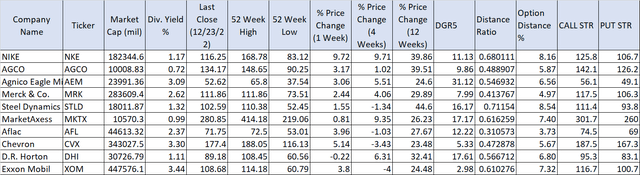
Here are the top 10 large-cap stocks for PUT options:
(NKE), (AGCO), (AEM), (MRK), (STLD), (MKTX), (AFL), (CVX), (DHI), (XOM)
Table 1:
Author
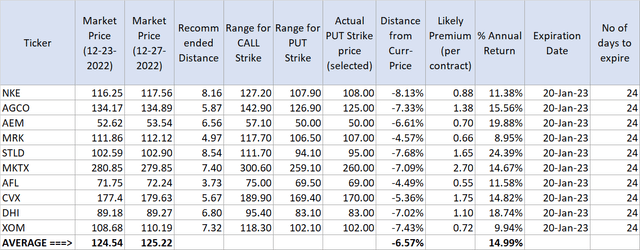
Below, we present the current PUT Options trades and current premiums that we can expect for the above 10 stocks. Please note that due to current market environment, we have selected very conservative strike prices and sacrificed a little bit of premium income. So, the average premium or annualized returns are slightly on the lower side.
Table 1A:
Author
10 Option Stocks With Safe Dividends (PART-A) #
In this category (part-A), we’re assuming that you already own these stocks (or you will be happy to own them at the right price). So, we’re aiming for an average of 2% dividend and roughly 10%-12% income by writing call options.
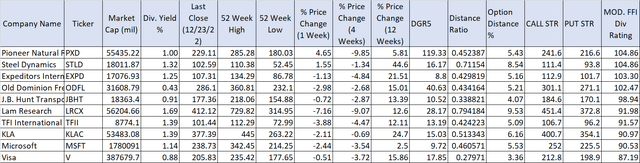
In this category, we will list 10 large-cap stocks that are perceived to have very safe dividends. There’s nothing that we can claim to be absolutely safe in the investing world – the same can be said about dividends. But based on various financial metrics, we can short list companies that have low payout ratios, low debt, high credit ratings, positive top-line growth, and have been consistently growing their dividends. We present ten such companies below:
Our Top 10 Stocks with Very Safe Dividends for (BUY-WRITE) CALL options:
(PXD), (STLD), (EXPD), (ODFL), (JBHT), (LRCX), (TFII), (KLAC), (MSFT), (V)
Table 2:
Author
Note: The “Dividend Rating” (the last column above) is based on recent past parameters like 5-year dividend growth, number of years of dividend growth, Payout Ratio based on cash flow, ROC, Sales growth, Debt/capital, and Relative Strength.
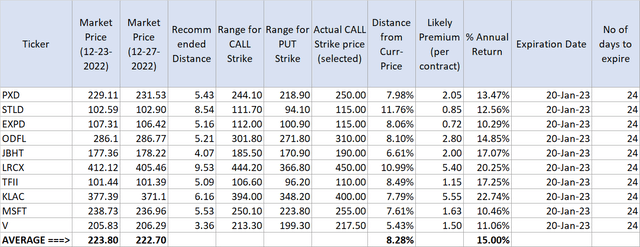
Below, we present the current CALL Option trades and current premiums that we can expect for the above ten stocks.
Table 2A:
(PXD), (STLD), (EXPD), (ODFL), (JBHT), (LRCX), (TFII), (KLAC), (MSFT), (V)
Author
10 Option Stocks With Safe Dividends (PART-B) #
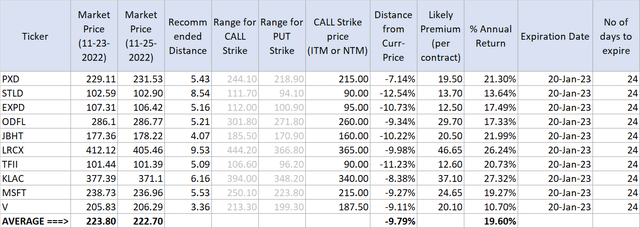
In this part, we are assuming that you do not own these stocks to start with, and your goal is NOT to own these stocks but simply to earn a high income (>= 20% annualized rate). Even then, there’s always a chance that we could end up owning these companies, so we want to make sure that their dividends are safe. Also, this option is better if you think that the market will fall from the current levels.
To achieve this, we will use the buy-write CALL option (for one contract, buy 100 shares and sell one call-option contract at the same time). Since the goal is simply to earn a high income, we will sell call option with a strike price that is either ITM (in-the-money) or NTM (near the money), meaning either below the current price or near the current market price. In fact, with the market going through a period of high volatility, we’re writing call options deep in-the-money. In normal circumstances, the odds will be very high that the shares will get called away, and we will earn a high premium. It’s also possible in some cases that the shares are not called away as the price may fall substantially. In such a case, our cost basis will be much lower (roughly 5% lower than the current price due to the premium already earned), and we can write another set of call-option.
However, there’s one caveat here, and it’s an important one. In case you write such call options on a large number of stocks (10 different stocks in our example below), and if the market was to take a deep dive (> 10% down) during the option period (which is always a possibility but more so in the current environment), the majority of our shares would NOT get called away, and you will end up owning most of these stocks, albeit at much-reduced cost basis (on average -7%). So, it’s important to know how much capital you’re willing to commit and if you can really afford to allocate it. Secondly, you always want to use this strategy with stocks that you do not mind owning and holding for an extended period of time.
This list of stocks is the same as in Part-A:
(PXD), (STLD), (EXPD), (ODFL), (JBHT), (LRCX), (TFII), (KLAC), (MSFT), (V)
Table 3:
Author
Conclusion #
We have presented two lists with 10 stocks each. The second list has been presented with two possible action strategies. In order to have a conservative strategy, we have limited our choices to stocks that are large cap (cap near or above $9 billion), pay respectable yields, have at least five years of dividend growth history, and generate enough cash to cover their dividends.
Please review the goals of each of the three distinct strategies carefully. We think these lists could be great selections for writing/selling PUT or CALL options. We have tried to put relatively safe stocks in all groups; however, the stocks listed in the second list (parts A and B) for call options (or buy-write call options) have been specifically filtered based on the safety of their dividends. However, nothing is absolutely safe in the investing world. Also, if generating income was your only objective, the second list (with the second option) is the safer bet.
We expect 60% to 80% of our options to expire worthless, earning us the upfront premium. But there will be times (just like the current market environment) when we’re assigned a stock. Usually, it should not be a problem, as we can turn around and write a covered call option. But there will be times, especially during high volatility periods, when the stock price may drop unexpectedly and significantly below our strike price. In such cases that are hard to predict, we will have to sell CALL options far out of money, earning us very little premium (or sometimes no premium at all) but still earning the dividends. This will reduce the overall premium yields by 2%-3% in the long term, but this can be easily offset by the capital gains we may earn from time to time. So, overall, it may be quite reasonable for us to expect 10% to 12% income on a consistent basis, as long as we play it wisely and conservatively.
In the current environment of great uncertainty, we need to be extra diligent in what stocks and strike prices we choose. There are many ways to determine the appropriate strike prices, but we have used our proprietary formulas to calculate the optimal strike prices. We suggest you perform your due diligence on each individual name if you decide to play the options.
The Wheel (aka Triple Income) Strategy Explained #
Original Post: See Edits at the bottom of the post for updates.
I’ve been asked and have explained The Wheel strategy many times, so I thought it may be a good idea to write it down all in one place for posterity!
This is the options strategy I use most often and IMHO it is about as safe and reliable as options trading gets. You will NOT get fantastic returns and it is quite boring and slow, but with the proper stock and patience, it can result in reliable profits and income. A 10% to 20%+ return is not difficult depending on a few factors, mostly based on stock selection, experience managing short puts and calls, plus the trader’s patience.
The Wheel (sometimes called the Triple Income Strategy) is a strategy where a trader sells cash secured Puts to collect premiums on a stock or stocks they wouldn’t mind owning long term. If the options expire or closed for a profit without being assigned, the premiums are all profit. The goal is to set up trades and avoid being assigned, but it is understood that if the put is assigned the account will buy and hold the stock. Through the collection of premiums, the initial cost basis of the stock can often be lower than the strike price paid.
The next step of The Wheel is to sell covered calls on the stock shares if assigned. It is highly preferable to sell a call with a strike higher than the stock’s cost basis, but this is not always possible. This is repeated over and over to collect even more premiums that continue to lower the stocks cost basis, and along with any rising stock price movement, works back to break-even or a profit.
At some point the call is exercised and the stock called away, or you can simply sell the stock, but when you add up all the premiums collected from selling the puts and calls, plus it is desired and common to end up selling the stock for a profit, this results in the Triple Income. If the stock pays a dividend while you own it then you can collect that as well (Quadruple income!).
Below is a graphic showing a simple spreadsheet to track the Credits and Debits to keep track of the overall position.
Step #1: Stock Selection – Most traders who have had a bad experience with the wheel have chosen the wrong stock. The stock(s) you chose must be a good candidate and one you don’t mind owning for some length of time, as it is possible you could own it for months.
Use your own criteria that fits your account and there is no one-size-fits-all way to choose stocks as only you can determine if you think the company is a good one to trade and hold if needed. Below are my general guidelines:
- A profitable company that has solid cash flow
- Bullish, or at least neutral chart trend and analyst ratings
- Priced around
$10 to $50Edit: $15 to up to about $100 now due to a higher account balance, but so I can afford to take the assignment if needed and I stay away from sub-$10 stocks as a rule - A stable chart without wild gyrations (especially those caused by CEO tweets!)
- A nice dividend is always a good thing, both that you may collect it if assigned the stock but also that dividend stocks tend to be more stable and predictable
Use your own fundamental analysis criteria to create a watchlist of 10 or so stocks that you can trade. If you find some lower priced ETFs, or have a larger account for the more expensive ones, then these can be included and make good candidates due to their normally steady movement, no ERs, and no CEO tweets. I look at my watchlist every few weeks and change it accordingly.
Step #2: Sell Puts – Selling short or Cash Secured Puts (CSPs) indicate you have the cash/margin to buy the stock if it is assigned. Be aware of any upcoming ER or other events that could cause a spike or movement in the stock, it is best to close or have the Put expire prior to the event, in effect skipping it and then continue selling CSPs afterward if the stock still meets the criteria.
Sell a Put on the selected stock: Below is a suggested model, but up to the individual trader:
- 30 to 45 DTE offers a good premium as the time decay curve starts to accelerate
- 70% Prob OTM or higher (~.30 Delta)
- A number of contracts are based on account size and if it is able to handle an assignment
- The Put can be closed at a 50% profit using a GTC Limit Order to close automatically. A put can then be sold on the same stock or another based on your opening criteria.
- Enter the Credits received, and any Debits paid to close or roll, on the Tracking P&L file
- Roll for a credit if the Put is challenged when possible, and provided a net credit can be made it can be rolled as long as needed which can also be used to track the stock’s movement by changing the strike price. See this post for more on rolling puts to avoid assignment: https://www.reddit.com/r/Optionswheel/comments/lliy8x/rolling_short_puts_to_avoid_assignment/
- If a credit cannot be made then it is best to take an assignment of the stock
The SP should be able to be sold over and over to collect as much premium as possible, and often never be assigned. If there is a fundamental change in the stock, close your position for an overall net profit and then move on to review and/or move on to another stock.
If assigned then Sell Covered Calls as shown in Step #3.
Step #3: Sell Covered Calls – Using the tracking file determine the net stock cost which is often already below where the stock is. As selling puts is usually the most profitable, some traders just sell the stock and move on to selling more CSPs, or sell a very high-value ITM Call that is sure to be called away and adds to the profit.
If your net stock cost is above the current market price and you keep the stock, then the goal is to sell CC premium to continue adding to the Credits and lowering the net stock cost below where the stock is trading before it gets called away.
Sell CCs, again here is a suggested process:
- Sell a Call above the net stock cost whenever possible, however, at times you may need to trade the strike below to get some good premium. Note that I will settle for a lower premium to be farther out to avoid the risk of early assignment and give the stock a chance to stabilize and possibly start to recover.
- Edit: Depending on the net stock cost I may sell an ATM CC for the next expiration date if it can result in a net profit. If the stock is below the net stock cost that I’ll look out to where I can sell a CC above the net cost to result in a profit if assigned. If I cannot sell a CC a reasonable time out (30ish DTE) then I am willing to hold the stock to wait for it to move back up.
Same as CSPs: 30 to 45 DTE, 70% Prob OTM or higher - If the call is not assigned then it can be closed for some level of profit and another sold until the net stock cost is below the current stock price.
- Track Credits and Debits, plus any Dividends captured, on the tracking file
- Continue this until the net stock cost is below the strike price at which time the stock can be left to be called away (some note that it cost less in fees to close the option and just sell the stock which accomplishes the same thing)
Step #4: Review and go back to Step #1 – This is why it is called the wheel as you start over again. The tracking file makes it easy to see the P&L, review the trade to verify the numbers and then look for the next, or same, stock to sell CSPs in Step #1.
As they say, rinse and repeat.
Risks and Possible Problems: The single biggest issue for this strategy is the stock price drops significantly, but this is no more risk than just owning the stock outright.
Stock Drops: The reason to make these trades on a stock you wouldn’t mind owning is because of this risk, and if a good stock is selected then this should be a very rare occurrence plus not a major issue.
- The price of the stock may drop well below the CSP strike and rolling for a credit will not be possible causing assignment.
- If CSPs were sold over and over the net stock cost may be much lower mitigating this drop in price.
- Management is to sell CCs over and over to allow time for the stock to recover, this can take time but when added to the CSP premiums collected the position can get “healthy” faster than you may think, however, this does take a lot of patience!
- There may be rare occasions when a stock is no longer viable (Enron?) and the position needs to be closed for a loss, again this shows the critical importance of stock selection.
Stock Rises: Many see this as a problem, but I personally do not as if the CC strike is above your net stock cost then the position profits, but just not as much.
- The stock is assigned and you sell CCs only to have the stock run well past your strike price.
- In most cases closing the CC and selling the stock outright can cause a bigger loss than just letting the stock be called at the strike price.
- It is, in this case, you may lament the profits that were “lost” by having the CC, but provided the above is done properly the position will still profit.
Impatience: By far this causes the most losses from this strategy!
- First, if you can’t roll for a credit let the CSP play out! If you close the CSP early it will cause a major loss.
- If you get assigned the stock and sell CCs, do not try to “save” the stock through buying it back at an inflated price! If you can’t roll for a credit then let the stock be called away and sell more CSPs to start the process over again provided the stock is still a viable candidate.
- Recognize it may take months selling CCs to build the premium up to a point where the net stock cost is less than the current stock price, but it will happen eventually if you can keep the CC from being exercised early.
A Tracking P&L File graphic is included and shows Credits and Debits to know where the position is at any given time. Note the stock price can be entered as a Credit to show where the position is at any given time. This is simple to create and use. NOTE: I do not send out copies as it would take me longer to do that than you recreating the 3 formulas.
Hopefully, this is a thorough and detailed trading plan, but let me know of any questions, typos or improvements you may have! -Scot

r/options - The Wheel (aka Triple Income) Strategy Explained
EDIT #1: Hello All, the response to this post has been amazing, thanks for the many who have contributed or inquired. Wanted to add a few things up front that seem to be causing confusion.
- The goal of this strategy is to collect the premium, NOT be assigned stock! While being ready and able to take the stock is part of the plan, being assigned is always to be avoided. If you sold a CSP 1 time and were assigned, you are either doing something wrong or are terribly unlucky by picking a stock that tanked.
CSPs should be sold over and over or rolled for a credit, to avoid assignment. You should be collecting 4 to 5 or more premiums worth several dollars before getting assigned. Some who have contacted me sold a CSP and just waited to be assigned, this is not the strategy.
If you are getting assigned more than a couple of times a year you may want to look at the stocks you are trading and how well you are managing your position. Getting assigned the stock should be a very rare occurrence.
-
As you select the stock and sell the CSP expect to get assigned. Be sure it is a low cost enough stock so that you can handle the shares and still make other trades. If you’re trading a $150 stock, be aware you could have $15K tied up for a while and be prepared to do that.
-
Going along with #2 I trade small and use lower to mid cost stocks. The premiums are not as juicy and the attraction of a TSLA or AMZN is hard to resist, but you are better selling 1 contract at a time for 10 positions than 10 contracts in one position and have to take 1000 shares.
It is always good account management to not trade more than about 5% of your account in any one stock to avoid news or movement from the stock from blowing up your account. It is also a good idea to keep 50% of your buying power available for safety and to take advantage of opportunities.
-
There have been negative nellies telling me this won’t work and being critical. Note that this is not my strategy and I don’t make any money from it being used or not. My time was spent in an effort to show one method options can more safely be traded, so if you have had a bad experience or think there are better ways, then feel free to post them!
-
Lastly, I have not done any research on this vs buying and holding stock. I’ve traded for more than 20 years with most of that time focused on stocks, and I did well!
Where I see the main differences are that options give leverage so I can collect premium from more stocks than just buying a couple, so this spreads out my risk. Also, I very much like the shorter time frame as I can move on to other stocks should one drop or run up. If done well you may only get assigned a couple of times a year and often be out of the stock in a couple of weeks.
OK, I think you will see this is not sexy or exciting trading, it is boring and you make $50 per position in many cases, but they add up. For those looking at huge returns and the excitement of major risk, this is not for you. If you want a more reliable way to trade options then this may be good to check out.
EDIT #2: I’ve updated this post now that it is unlocked. Some changes include:
- Stock price minimums moving up as I now have a larger account
- Selling CCs based on if the net stock cost is above or below the current stock price
- Added a rolling put link.
- There are many different wheel strategies today with some selling ATM puts, others only selling covered calls (not sure how that is a wheel), and several other variations. This is what I trade and it is up to you how you trade.
What is the wheel strategy? | The Wheel Strategy #
This is one of the safest options strategies that you can find in the market. This primarily involves 2 legs that consist of selling cash-secured puts (CSP) and selling covered calls ( CC). It starts with the first leg of selling a cash-secured put on a stock that you want to own at a certain price. You then keep selling puts until assigned and once assigned you then start selling covered calls against the same stock until it gets called away. That completes a full circle and you start again from the beginning by selling puts. In all of this, you collect a premium at every step plus any capital gain on the stock that you get when your stocks are called away.
Overall it is a Win-Win strategy from all sides as long as you follow a few things and run the wheel on good stock.

wheel strategy poster
What are cash-secured puts? #
This is leg 1 of the wheel strategy. ( Refer to the yellow box in the diagram below) In very simple terms you basically agree to buy 100 shares of a stock at a certain price only if it hits that price on the day of option expiration. For this, you put money equal to the purchase price of 100 stocks as collateral and in exchange for that, you get to keep the premium.
What is the covered call strategy? #
This is leg 2 of the wheel strategy ( Refer to the yellow box in the diagram below). This is exactly the opposite of Cash secured put. Once you have 100 shares of stock assigned you to sell a covered call against that. In simple terms, you agree to sell 100 shares of a stock at a certain price only if it hits that price on the day of option expiration. For this, you put your 100 shares as collateral and in exchange for that, you get to keep the premium.
https://googleads.g.doubleclick.net/pagead/ads?client=ca-pub-4367924245715011&output=html&h=280&slotname=2818748804&adk=950649815&adf=3780039712&pi=t.ma~as.2818748804&w=823&fwrn=4&fwrnh=100&lmt=1673850624&rafmt=1&format=823×280&url=https%3A%2F%2Finvesting20.com%2Fwheel-strategy%2F&host=ca-host-pub-2644536267352236&fwr=0&fwrattr=true&rpe=1&resp_fmts=3&wgl=1&uach=WyJXaW5kb3dzIiwiMTAuMC4wIiwieDg2IiwiIiwiMTA5LjAuNTQxNC43NCIsW10sZmFsc2UsbnVsbCwiNjQiLFtbIk5vdF9BIEJyYW5kIiwiOTkuMC4wLjAiXSxbIkdvb2dsZSBDaHJvbWUiLCIxMDkuMC41NDE0Ljc0Il0sWyJDaHJvbWl1bSIsIjEwOS4wLjU0MTQuNzQiXV0sZmFsc2Vd&dt=1673850624716&bpp=9&bdt=1730&idt=178&shv=r20230111&mjsv=m202212050101&ptt=9&saldr=aa&abxe=1&cookie=ID%3D3b0d270be110fd59-2242978449d900c2%3AT%3D1673849444%3ART%3D1673849444%3AS%3DALNI_Mbg96RemyG0gmcGPtkB1lUCWQqo8A&gpic=UID%3D00000ba53d31127b%3AT%3D1673849444%3ART%3D1673849444%3AS%3DALNI_Mb6eHNXEotNlM4AzLqUfpvjb4ryZA&correlator=1949236965862&frm=20&pv=2&ga_vid=238656898.1673844068&ga_sid=1673850625&ga_hid=1191457049&ga_fc=1&u_tz=240&u_his=4&u_h=1152&u_w=2048&u_ah=1112&u_aw=2048&u_cd=24&u_sd=1.25&dmc=8&adx=340&ady=1980&biw=1890&bih=1002&scr_x=0&scr_y=0&eid=44759876%2C44759927%2C44759837%2C31071011&oid=2&pvsid=4010391759943435&tmod=1879458036&uas=0&nvt=1&ref=https%3A%2F%2Finvesting20.com%2Fbest-stocks-for-wheel-strategy%2F&eae=0&fc=896&brdim=28%2C0%2C28%2C0%2C2048%2C0%2C1920%2C1120%2C1906%2C1002&vis=1&rsz=%7C%7CeEbr%7C&abl=CS&pfx=0&fu=128&bc=31&ifi=1&uci=a!1&btvi=1&fsb=1&xpc=g3SFehRlrI&p=https%3A//investing20.com&dtd=210
As you can see you get to keep the premium no matter what.
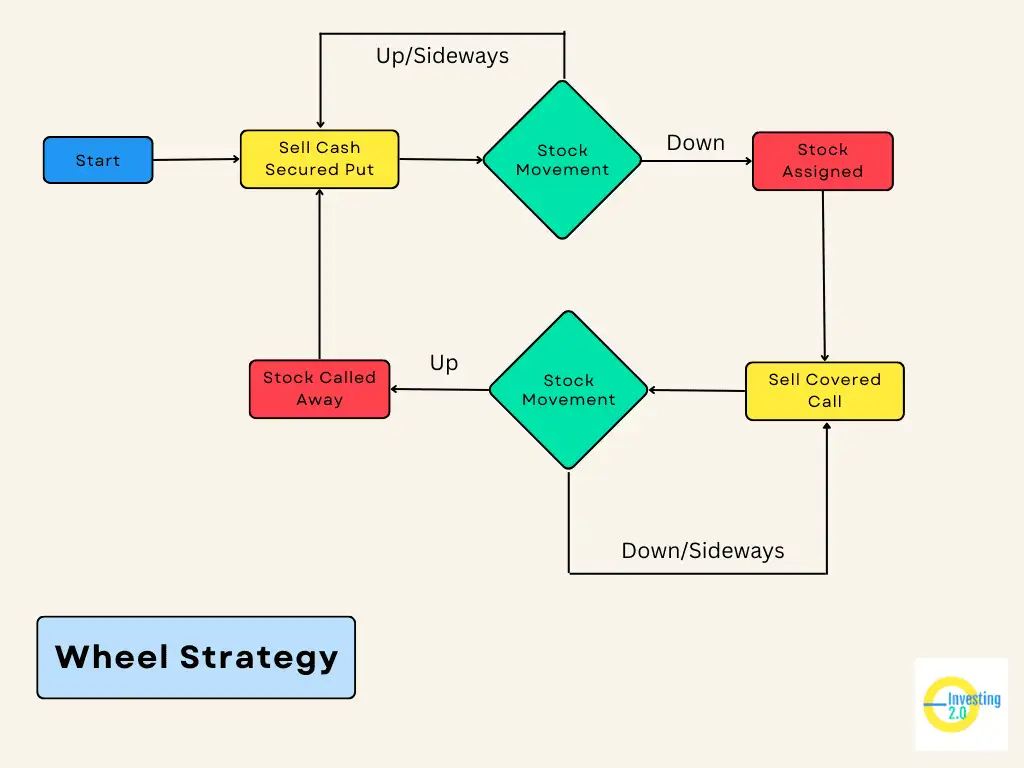
Wheel Strategy Options
Now let’s understand the steps of the wheel with an example
https://googleads.g.doubleclick.net/pagead/ads?client=ca-pub-4367924245715011&output=html&h=280&slotname=2818748804&adk=950649815&adf=2549473649&pi=t.ma~as.2818748804&w=823&fwrn=4&fwrnh=100&lmt=1673850625&rafmt=1&format=823×280&url=https%3A%2F%2Finvesting20.com%2Fwheel-strategy%2F&host=ca-host-pub-2644536267352236&fwr=0&fwrattr=true&rpe=1&resp_fmts=3&wgl=1&uach=WyJXaW5kb3dzIiwiMTAuMC4wIiwieDg2IiwiIiwiMTA5LjAuNTQxNC43NCIsW10sZmFsc2UsbnVsbCwiNjQiLFtbIk5vdF9BIEJyYW5kIiwiOTkuMC4wLjAiXSxbIkdvb2dsZSBDaHJvbWUiLCIxMDkuMC41NDE0Ljc0Il0sWyJDaHJvbWl1bSIsIjEwOS4wLjU0MTQuNzQiXV0sZmFsc2Vd&dt=1673850624759&bpp=4&bdt=1774&idt=305&shv=r20230111&mjsv=m202212050101&ptt=9&saldr=aa&abxe=1&cookie=ID%3D3b0d270be110fd59-2242978449d900c2%3AT%3D1673849444%3ART%3D1673849444%3AS%3DALNI_Mbg96RemyG0gmcGPtkB1lUCWQqo8A&gpic=UID%3D00000ba53d31127b%3AT%3D1673849444%3ART%3D1673849444%3AS%3DALNI_Mb6eHNXEotNlM4AzLqUfpvjb4ryZA&prev_fmts=823×280%2C0x0&nras=1&correlator=1949236965862&frm=20&pv=1&ga_vid=238656898.1673844068&ga_sid=1673850625&ga_hid=1191457049&ga_fc=1&u_tz=240&u_his=4&u_h=1152&u_w=2048&u_ah=1112&u_aw=2048&u_cd=24&u_sd=1.25&dmc=8&adx=340&ady=2527&biw=1890&bih=1002&scr_x=0&scr_y=0&eid=44759876%2C44759927%2C44759837%2C31071011&oid=2&pvsid=4010391759943435&tmod=1879458036&uas=0&nvt=1&ref=https%3A%2F%2Finvesting20.com%2Fbest-stocks-for-wheel-strategy%2F&eae=0&fc=896&brdim=28%2C0%2C28%2C0%2C2048%2C0%2C1920%2C1120%2C1906%2C1002&vis=1&rsz=%7C%7CeEbr%7C&abl=CS&pfx=0&fu=128&bc=31&ifi=3&uci=a!3&btvi=2&fsb=1&xpc=aksu4Q4Fhj&p=https%3A//investing20.com&dtd=312
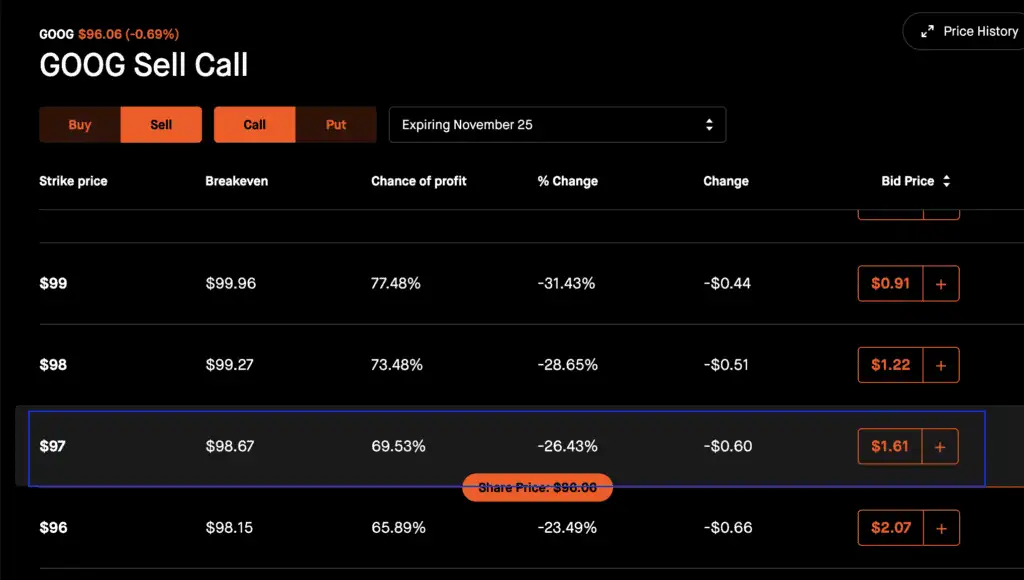
Let’s taken a concrete example from the Robinhood platform to understand this strategy. The price of Google Stock as of the writing of this article is about $96 and you want to run the wheel on it.
- The first step is to sell a cash-secured put on Google. You first select Sell/Put from the top and select expiry as a week in advance. You then select $95 as your strike price. For this, you will get a premium of about $158 and you have to put $9500 as collateral.
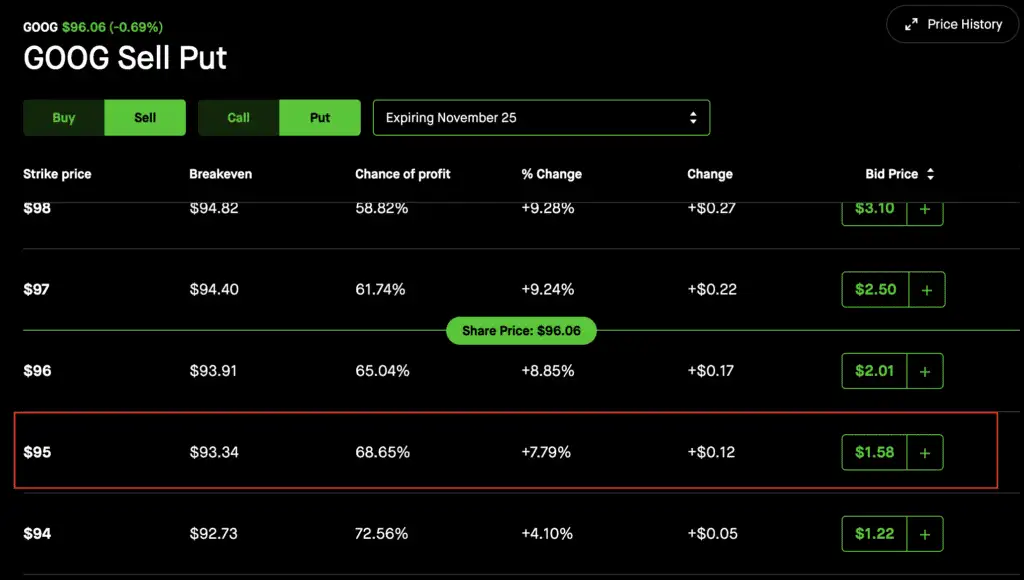
cash secured put
2. At expiry, if the google stock closes above your strike price of $95. Your collateral money is released and you also get to keep all the premiums.
3. You repeat step 1 of selling CSP again next week and collect the premium. You keep doing this until the google stock closes below your strike price of $95.
4. Stock Assignment – If google closes below your strike price you are required to buy the google stock at the strike price of $95. As a result of this, you now own 100 shares of google at $95 for each stock.
5. Now you turn the wheel and start selling covered calls against the stock. You pick the strike price let’s say $97 and select the expiry of the week ahead. You get a premium of $161.
covered call
6. You keep repeating step 5 of the selling covered call until google stock closes above your stick price of $97.
7. Stock Called Away – If the stock closes above your strike price of $97 you have to sell your shares. However, you will have a $200 profit from the stock since you bought it at $95. Plus you get to keep the premium.
8. This completes the full circle of the wheel and you restart the wheel from step 1.
How to select the best stock for wheel strategy #
- Liquidity is very important when selecting any stock options and the same applies to the wheel strategy. You need to ensure that there is a good amount of volume for the stock you plan to do wheel strategy.
- Run the wheel strategy on a stock that you really like to own in your portfolio.
- Avoid stocks with high volatility, they tend to have high price swings which are not what you want to run the wheel strategy.
- Consider selecting stock with a low beta value. This is another indicator that you can use to avoid high swings stocks.
- Take advantage of the Bollinger band indicator to identify stocks that are mostly range bound. It’s preferred to have a stock that doesn’t is range bound.
- Use this site to find a good liquid and active option to run a successful wheel strategy.